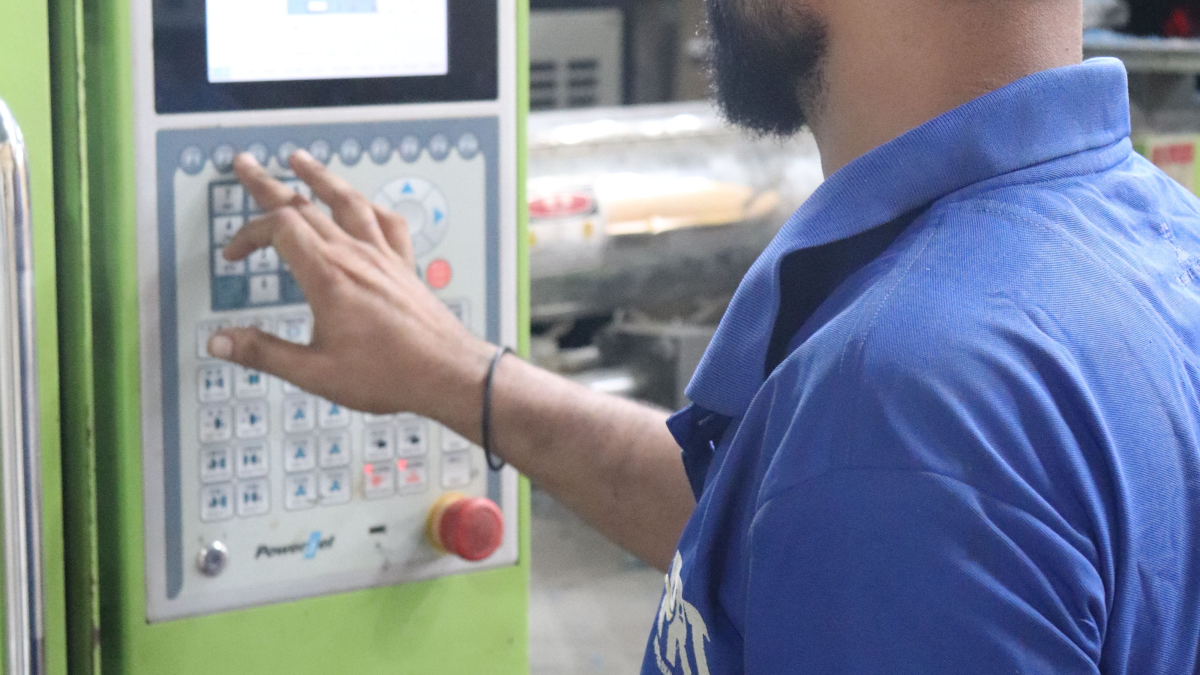
CNC operator work in Poland remains one of the notable manufacturing professions. There are vacancies in the furniture sector, metalworking, window systems, series production of parts, and in areas with milling and turning machines. For the market, this is no longer a one-time shortage of personnel, but a constant need: there is a lot of equipment, but significantly fewer people who can consistently maintain the process.
At the same time, the number of job postings alone explains little. Under the same wording 'CNC operator', very different roles can be hidden. In some cases, it refers to simple series work with a repeating cycle, while in others, the person is expected to read drawings correctly, perform measurement control, understand setup, and react quickly to deviations. The prospects in the profession depend precisely on this difference.
Why the demand for CNC operators in Poland remains stable
Polish manufacturing has long relied on areas where the machine automates the cycle itself, but does not eliminate the need for a person. The workpiece needs to be set up correctly, the tool needs to be checked on time, the size needs to be controlled, and instability must be noticed before it turns into a series of defects. In practice, this is where the real value of the operator is determined.
The need is most evident in enterprises where downtime quickly turns into money. When a line loses pace due to repeated minor failures, poorly prepared tooling, installation errors, or missed tool wear, it becomes clear that an operator is needed not as a formal unit in the staff. A person is needed who keeps the area in working rhythm.
There is also a structural reason for the demand: some companies are expanding their machine park faster than they can prepare people internally. A new machining center can be purchased in a short time. It is more difficult to prepare a specialist who can enter stable work on such equipment without fuss and unnecessary risk in the same timeframe.
Where in Poland this profession has more opportunities
The situation heavily depends on the region and type of enterprise. In some areas, there is a higher concentration of furniture production and panel materials, while in others, there is more metalworking, automotive parts, construction components, or series orders for industry. For a specialist, this has direct significance: along with the industry, the requirements, pace of work, and depth of tasks change.
In areas with simple repeating series, entering the profession is easier. Such places are often open to people with less experience if they have discipline, attentiveness, and a willingness to learn quickly. However, the professional ceiling is usually lower there. In more complex areas, entry is harder, but experience accumulates faster, which is then valued in other companies.
Therefore, it is useful to look not only at the starting conditions but also at the content of the work itself. One year of experience in two different productions can yield completely different results. In one case, a person remains an executor of a narrow operation. In the other, they gain a foundation for growth in setup, technological support for the area, or programming.
What skills genuinely increase the value of an operator
At the initial level, an employer may only need a careful person who maintains pace, does not break discipline, and does not get lost in the repeating cycle. However, the market significantly values those who can go beyond the simplest set of actions.
The first thing that truly affects a specialist's value is working with size and repeatability. If an operator notices parameter drift not after accumulated defects but earlier, they are already reducing part of the production risk for the area. For the employer, this is much more important than a beautiful wording in a resume.
The second level is understanding the logic of the process. It is not necessary to be a CNC programmer right away, but it is useful to see why the setup is unstable, where the weak point in the clamping is, why the tool starts to behave worse than usual, and what affects the repeatability of the series. This process-oriented approach distinguishes a person who simply executes the cycle from a specialist who can maintain its stability.
The third important block is reading drawings and measurement control. In many areas, this is where the boundary lies between an employee who can be trusted with more responsible tasks and an employee who requires constant verification.
- reading technical drawings;
- working with calipers, micrometers, and basic measurement control;
- understanding tolerances and critical dimensions;
- careful work with tools, corrections, and changing tooling;
- the ability to calmly analyze a recurring failure rather than acting randomly.
What growth looks like in the profession
The profession of CNC operator in Poland has a normal development trajectory, but it does not appear automatically with experience. The duration of work alone does not make a specialist stronger. It is much more important what tasks they gradually take on and how much they expand their technical base.
If experience consists only of a uniform series without understanding measurement, setup, and causes of deviations, then after several years, the value of such a specialist grows slowly. Formally, they have experience, but for the employer, they are still a person with a narrow set of actions.
If an operator begins to understand the installation of parts, typical sources of defects, tool operation, basic corrections, and the logic of cycle preparation, their position in the market changes. Then real transitions to senior operator, setup technician, series launch specialist, technological assistant for the area, and sometimes even CNC programmer appear.
Therefore, prospects in this profession are better evaluated not by the job title but by whether the specific work provides access to more complex areas of the process.
What often hinders development
One typical problem is too narrow specialization in one repeating area. A person works for years without serious failures but hardly steps outside the familiar cycle. For the internal stability of the enterprise, this may be convenient, but in the market, such experience does not always provide a strong position.
The second problem is a weak technical base. If a specialist avoids drawings, does not like measurement, does not try to understand the cause of deviations, and always waits for a ready answer from a more experienced colleague, growth goes noticeably slower. At some point, it is no longer about a lack of time but about a professional approach to work.
The production environment itself can also hinder progress. There are areas where an employee is kept only in the role of an executor and is not allowed to see the process more broadly. In such a place, one can gain work experience but not acquire the experience that later increases the value of a specialist when changing companies.
What automation changes
Automation does not eliminate the profession of CNC operator but changes its content. The more stable and faster the cycle goes, the more expensive an error becomes if it goes unnoticed. An automated area can repeat the correct solution many times. It can just as easily repeat an error if a person does not stop it in time.
Therefore, in more automated productions, operators are increasingly expected not to be mechanically present near the machine but to carefully control the process. Here, the value of attentiveness, technical understanding, and careful reaction to deviations is higher.
For a specialist, this is more of an opportunity than a threat. The better a person understands the process, the easier it is for them to fit into such an environment, and the higher their professional stability in the market.
What are the current prospects for this profession in Poland
The demand for CNC operators in Poland remains high, but within this profession, there is a noticeable stratification. Simple positions with a limited set of tasks will continue to exist, but it is more challenging to build long-term growth on them. More interesting opportunities arise where a specialist is expected not only to execute the cycle but also to provide proper technical support for the area.
For a newcomer, this is a working entry into the industry if there is a willingness to discipline, attentiveness, and gradually build a base. For an experienced person, this profession retains prospects if the experience turns into a broader set of skills: measurement, reading drawings, understanding setup, process stability, and participation in setup.
In Poland, the profession of CNC operator remains in demand because production still depends on people who can maintain repeatability, notice risks in advance, and prevent minor instability from turning into lost time, defects, and a slowdown in pace in the area.