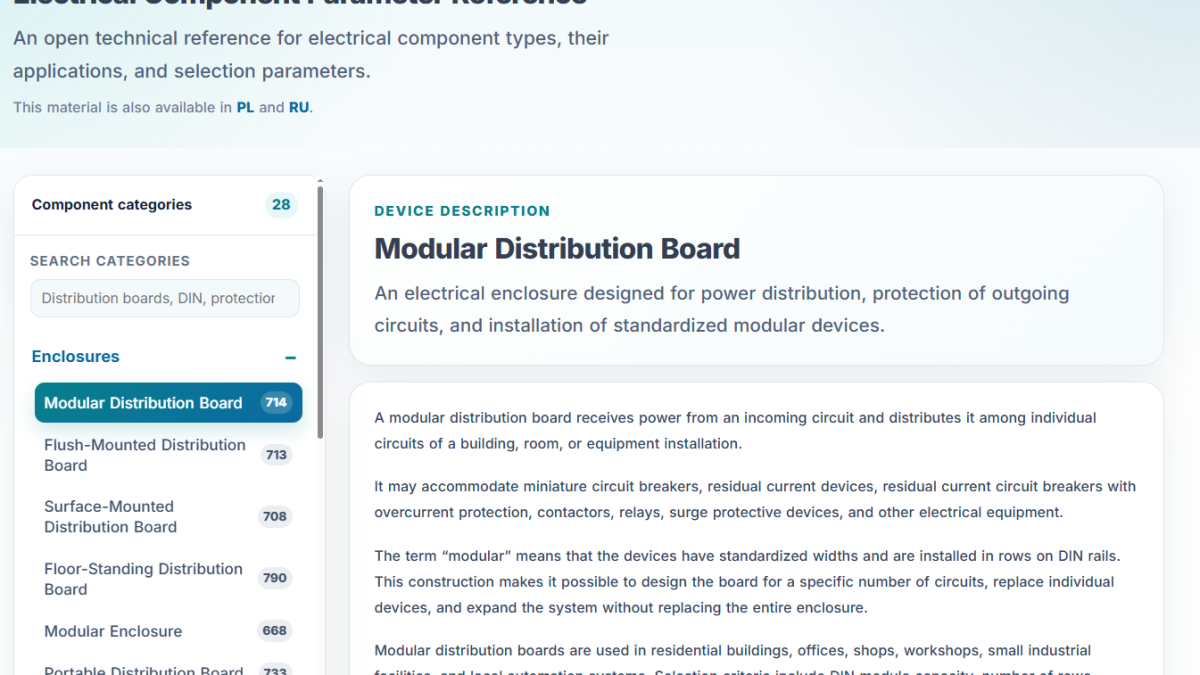
A component name alone is rarely enough to make a sound electrical selection. A circuit breaker must be checked for rated current, breaking capacity, and tripping characteristic. For a contactor, the application category, coil voltage, and permissible load matter. A distribution board brings a different set of questions: module capacity, mounting method, enclosure rating, and usable internal space. The new TRASA3 electrical component parameter reference helps users identify the specifications worth checking for each type of product.
The reference is part of the open TRASA3 knowledge base and runs in a browser. Its content is organised by component category, making it useful when preparing a specification, comparing supplier offers, completing product records, or reviewing a technical description.
From component type to a structured specification
The reference is designed to show the data structure relevant to a selected product. Users choose a group and component type, then see its purpose, description, and applicable parameters. This is more practical than working through one long alphabetical glossary because every characteristic appears in the context of the equipment it describes.
For a modular distribution board, for example, the reference covers enclosure construction, the number of rows and modules, installation method, dimensions, material, IP rating, impact resistance, door configuration, cable entries, and operating conditions. Separate groups address compatibility, markings, documentation, packaging, and transport. These details may be absent from a short product name, yet they can directly affect installation, purchasing, and service.
What a component record contains
Each parameter includes a concise explanation. Where a measured value is expected, the relevant unit is displayed alongside it, including volts, amperes, millimetres, kilograms, and cubic metres. The description explains what the field represents; it does not assign one universal value to every product of that type.
Parameters are arranged in subject groups. Their exact composition varies by component, but a record may include:
- primary electrical ratings and nominal values;
- construction, materials, and dimensions;
- mounting method, connections, and compatibility;
- protection ratings and environmental conditions;
- standards, certificates, and technical documentation;
- identification, commercial, and logistics data;
- package dimensions, weight, and storage requirements.
The grouping supports different workflows. A designer may focus on electrical and mounting properties, a purchasing specialist on identifiers and packaging, and a product data specialist on the completeness and consistency of the record.
Finding a parameter inside a detailed record
The reference includes parameter search. It provides a quick route to a particular characteristic in a large record containing many fields. This is useful when the immediate task is to check a single point such as the operating temperature range, terminal type, overall depth, protection class, or availability of a document.
The navigation keeps every parameter connected to its component type. A definition therefore remains part of the product's overall data structure. Similar field names are easier to relate to an actual task, whether that is designing a panel, replacing a device, preparing a supplier enquiry, or normalising a catalogue.
A practical example: preparing a supplier enquiry
Consider a requirement for a distribution board in a small installation. Asking only for a board with a specified number of modules leaves several questions unanswered. The proposed product could be surface-mounted when a flush-mounted enclosure is needed. Its housing may be unsuitable for the room, while its dimensions or cable-entry arrangement may complicate installation.
The component record provides a starting checklist: number of rows and modules, mounting method, overall dimensions, enclosure material, door and lock configuration, IP rating, permitted temperature range, cable-entry options, supplied accessories, and documentation. The checklist can then be reduced to the requirements that matter for the project. Suppliers receive a clearer enquiry and their responses become easier to compare.
The same approach is useful when replacing a discontinued product. A model number does not reveal which properties must be preserved. A structured record supports comparison of the old and new devices by function, mounting, electrical characteristics, and operating conditions. The final decision still needs to be verified against manufacturer documentation and project requirements.
Where the reference ends and manufacturer documentation begins
The service explains parameters and their purpose. It does not replace a product data sheet, installation manual, wiring diagram, or certificate of conformity. Actual values depend on the manufacturer, series, and product variant. Designers and installers must confirm the selected model against current technical documentation and the rules applicable to the project.
This distinction is especially important for safety-related data such as breaking capacity, operating voltage, short-circuit ratings, ingress protection, temperature limits, and installation conditions. The reference helps establish which details should be requested and compared. Evidence for a particular device must come from its product documentation.
Who can use the new knowledge-base section
The material supports professionals working with electrical products at different stages of their lifecycle. This includes electrical installers and designers, automation engineers, purchasing teams, technical catalogue editors, developers of industry information systems, and students in technical disciplines.
For a newcomer, the reference provides a map of common characteristics and introduces professional terminology. An experienced engineer can use it to prepare a requirements list more efficiently. In catalogue work, a consistent set of fields makes products from different manufacturers easier to compare and helps reveal missing source data.
The TRASA3 knowledge base is available without additional software. The electrical component parameter reference is already accessible in English; users can select a product type in the catalogue and proceed directly to its characteristics.