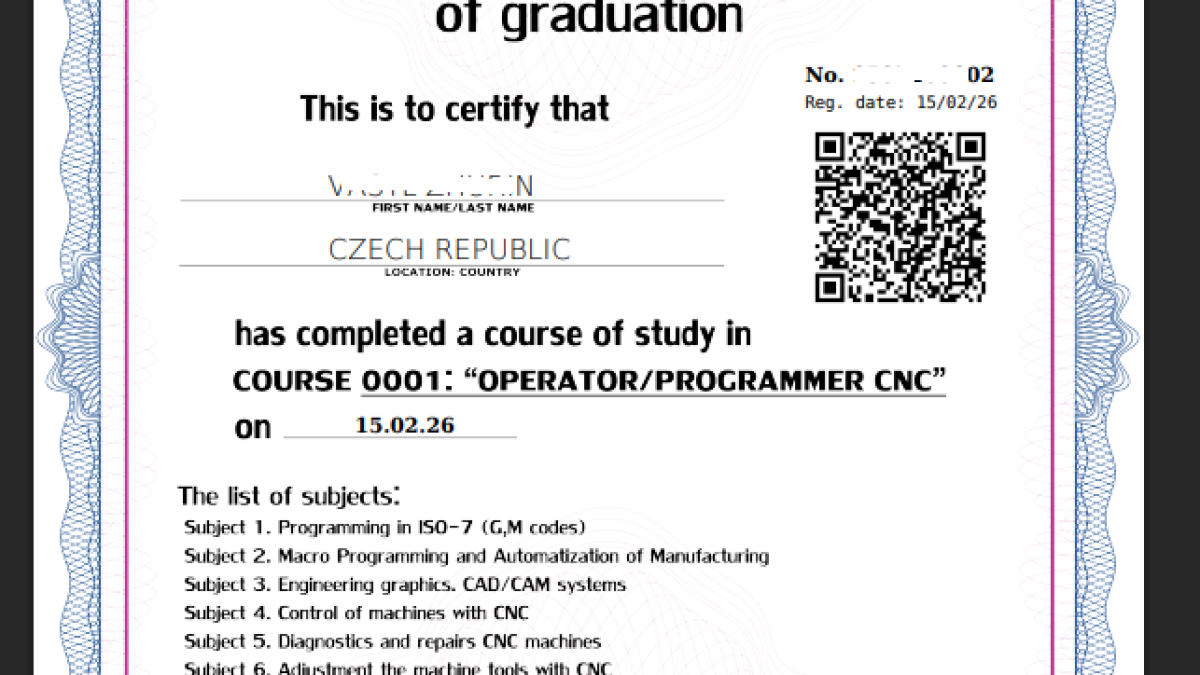
In a CNC career, a certificate rarely solves everything by itself. Employers still look at machines, materials, drawings, inspection, setup, CAM and real parts. A good certificate or verified skills record reduces uncertainty: the candidate is not only listing familiar words, but showing that they can perform specific production tasks.
This matters most during career transitions: from operator to setup, from setup to CAM programming, or from one machine type to more complex work. In those transitions, a resume often looks weaker than the person’s actual shop experience. Verification helps describe that experience in a way employers can understand.
What a Certificate Proves
A certificate is useful when it is tied to a clear competence: drawing reading, measurement, CNC mill operation, CNC lathe operation, CAM milling, CAM turning, five-axis setup, quality or safety. NIMS, for example, lists machining credentials such as CNC Mill Operations, CNC Mill Programming, Setup, and Operations, CNC Lathe Programming, Setup, and Operations, CAM Milling I, CAM Turning I and five-axis mill setup. That structure helps an employer see which part of the process was assessed.
A certificate does not show the whole picture. It may confirm theory knowledge or completion of a standardized task, while the real shop adds material behavior, tool wear, imperfect stock, urgent orders, control-specific details and first-part responsibility. That is why certification works better when paired with work examples: part photos, setup description, inspected dimensions, a CAM file, posted G-code or a short explanation of an error that was corrected.
A strong resume formula is simple: the certificate identifies the area, and the example proves application. A line saying completed CAM course is hard for a recruiter to evaluate. A small production example with tool, material, control and result makes the conversation concrete.
Why Employers Care About Verification
Hiring a CNC specialist carries risk. A poor decision can mean scrap, broken tools, damaged fixtures, machine downtime or a delayed batch. Employers therefore try to understand more than years of experience. They need to know whether the person can read a drawing, set G54, check an offset, notice unsafe G-code motion, measure the first part and explain the cause of deviation.
O*NET describes CNC tool operators as workers who operate computer-controlled machines, measure finished parts, mount tools and fixtures, review specifications or drawings and adjust machining parameters. For CNC tool programmers, O*NET describes a different level of responsibility: developing programs, determining operation sequence, selecting tools, calculating speeds and feeds, running trial cuts or simulations and correcting programs. These descriptions show why verification must be specific.
If a candidate confirms only general CNC experience, the employer still does not know where responsibility begins and ends. Verified setup, inspection or CAM tasks make it easier to match the candidate with the correct role and pay range.
Which Proof Works Best
The strongest proof is connected to work that can be checked. For an operator, that may be inspection results, knowledge of the operation sheet, stable work with approved programs, understanding part zero and safe cycle start. For a setup specialist, it is starting a new batch, setting work offsets, loading tools, releasing the first good part and making corrections after measurement. For a CAM programmer, it is toolpaths, collision checking, postprocessor output, setup sheets and the result on the machine.
Several small proofs are often better than one broad claim. One shows basic literacy, another shows independence, and a third shows the ability to handle a harder task. For example: a CNC milling certificate, a 2.5D part portfolio, a short G-code simulation video, a setup description and a list of measuring tools the candidate has actually used.
TRASA3 can be part of that preparation and demonstration. G-code reading practice, motion simulation, program-logic exercises and error checking help candidates explain their level more clearly. For an employer, this does not replace a shop trial, but it adds a signal of learning discipline.
How Certifications Lead to Better Offers
A certificate does not have to raise pay automatically. It helps the candidate enter the right conversation. If a recruiter sees only CNC operator and five years of experience, they may offer a standard operator job. If the resume shows setup, first-part work, CAM, inspection and verified tasks, the candidate is easier to consider for a stronger role.
This is especially useful when moving between countries, cities or production types. Job titles vary between companies: CNC operator, CNC machinist, setup operator, CAM programmer, manufacturing technologist. Verifiable skills help translate experience from one job-title language into another. An employer may not know the candidate’s previous company, but they understand G54, micrometer, Fanuc, 2.5D milling, first article inspection and collision check.
Ukrainian and international CNC job ads regularly ask for drawing reading, measuring tools, setup ability, CAM knowledge or specific controls such as Fanuc, Siemens Sinumerik, Heidenhain and Haas. A certificate or skills verification is most valuable when it matches those requirements instead of sitting as an isolated line at the end of the resume.
How to Present Proof in a Resume
The certification section should be short and technically clear. Include the title, organization, date, skill area and, when available, a link to a verifiable badge or result page. A resume does not need every online course ever completed. Keep the credentials that help explain your real role.
Next to the certificate, add practical facts. For example: prepared 2.5D CAM operations for an aluminum part; checked G-code in a simulator; set G54 and tool length offsets; inspected a dimension with a micrometer; helped release the first part. These lines connect the document with production.
If you have a portfolio, keep it careful and safe to share. Do not publish customer drawings, part numbers, defense products, internal setup sheets or confidential cutting data. Anonymized photos, your own training models, simulation screenshots, operation lists and notes on errors found and corrected are enough.
Choosing the Right Certification
The choice depends on the target role. A new operator benefits more from proof of safety, drawing reading, measurement and basic machine operation. An operator aiming for setup needs tasks around tool setting, work offsets, first-part approval, compensation and program checking. A future programmer needs CAM, G-code, postprocessors, toolpaths and control knowledge.
Look at the vacancies you want to apply for in the next 6-12 months. Write down repeated requirements: machines, controls, CAM systems, materials and responsibility level. Then choose training and verification that match those requirements. Certification becomes part of a career plan rather than a random purchase.
When choosing between a broad impressive certificate and a narrower practical task, the practical task is often more useful in CNC hiring. Employers care more about whether a candidate can launch an operation safely, inspect a part and explain a correction than about a general promise of technical competence.
A Short Plan for Candidates
First, choose the role you want next: operator/setup, CNC machinist, CAM programmer or technologist. Then select three to five skills required for that role. For each skill, prepare evidence: a certificate, simulation, part photo, setup description, measurement list or short G-code review.
- For operators: safety, operation sheets, measurement and dimension control.
- For setup: G54/G55, tool offsets, first-part approval and scrap troubleshooting.
- For CAM programmers: 2.5D, 3D strategies, collision checking, postprocessor output and setup sheets.
- For technologists: routing, stock choice, fixtures, inspection steps and coordination between production areas.
After that, update the resume around verified actions rather than course names. In interviews, speak about details: material, machine, control, the error found, how it was found and which dimension was checked. That kind of conversation helps the employer assess level faster and usually leads to a more accurate role.
CNC certifications and skill verification work best when they are connected with real practice. The document opens the door, the verified task holds attention, and a clear production example helps negotiate a job that matches the candidate’s actual level.